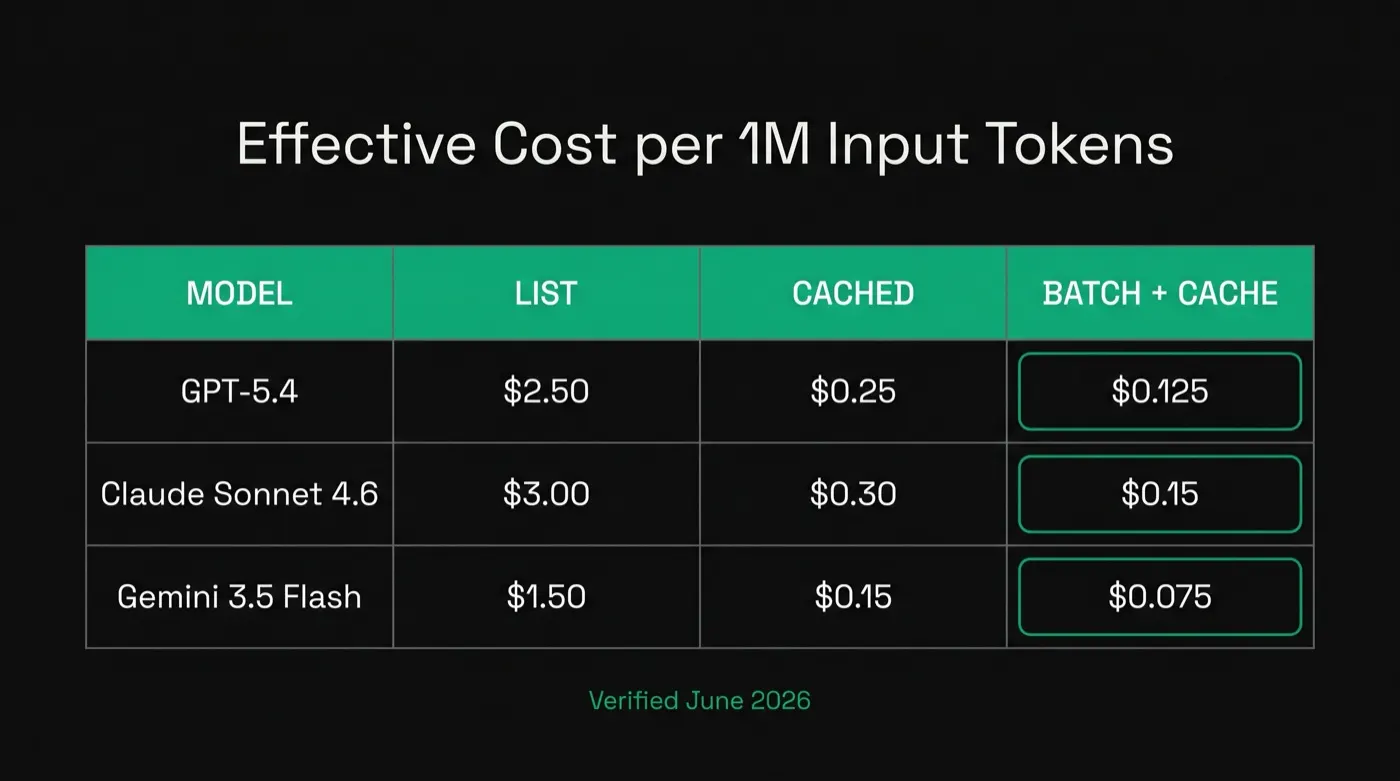
List prices are fiction for any optimized LLM workload. All three major providers now discount cached input by at least 90%, and all three discount batch processing by 50% on input and output. Stack them where stacking is supported and your effective price runs 5–50% of list. Claude Sonnet 4.6's $3.00 input becomes $0.15. gpt-6-luna's $0.10 becomes $0.005. This page computes the real numbers — every cell derived from provider list prices using a stated multiplier methodology, so you can check the arithmetic yourself. Self-hosted models get the same kind of saving from reused prompts: see prefix caching, measured in vLLM and Ollama.
Last checked: September 27, 2026
Every list price on this page was checked against the provider's own pricing page on 2026-06-10, re-confirmed unchanged on 2026-07-15, and checked again on 2026-09-27, when DeepSeek's peak and off-peak pricing and the newer OpenAI, Anthropic, and Gemini models went in. Computed cells are pure arithmetic on those prices. See the changelog at the bottom for the history and the monthly re-check commitment.
Loupe by LeanLM (not affiliated with Google's LearnLM educational AI) measures what AI workloads cost in energy per request — this page is our reference table for what optimized workloads actually pay per million tokens.
Most LLM cost comparisons stop at list price, which makes them useless for anyone running LLM caching or asynchronous pipelines. The gap between list and effective price is now so large that list-price comparisons routinely point teams at the wrong provider. (And if your volume is high enough, the cheaper option may not be an API at all — see when self-hosting an LLM beats the API on cost.) Below: the effective-cost leaderboard, then the methodology, the full per-provider tables, and the value picks.
Effective Cost Leaderboard: Cheapest LLM APIs by Real Cost (September 2026)
The bottom line — as of September 27, 2026
The cheapest effective LLM API cost is DeepSeek's deepseek-flash (V4.1 Flash) at $0.003 per million input tokens on off-peak automatic cache hits ($0.006 at peak), a 98% discount off its $0.15 off-peak list price. Among models that stack batch + cache discounts, gpt-6-luna leads at $0.005/MTok, and Claude Opus 5.5 is the cheapest flagship-class option at $0.10/MTok stacked. These are effective prices — what optimized workloads actually pay after caching and batch discounts — not list price, which overstates real cost by 20–50× and is what most "cheapest LLM" comparisons and benchmark leaderboards report.
Ranked by cheapest effective input cost per million tokens (stacked batch + cache where supported; DeepSeek uses its automatic off-peak cache-hit rate, which has no batch tier to stack). Every figure is derived from the provider's own list price using the stated multiplier methodology below — rechecked 2026-09-27, nothing recalled from memory or third-party trackers. The ranking covers the models in the tables below; older models still on the providers' price lists are left out.
| Rank | Model | Provider | Effective input $/MTok | How |
|---|---|---|---|---|
| 1 | deepseek-flash (V4.1 Flash) | DeepSeek | $0.003 | automatic cache-hit, off-peak ($0.006 peak) |
| 2 | gpt-6-luna | OpenAI | $0.005 | batch + cache stacked |
| 3 | gpt-5.4-nano | OpenAI | $0.01 | batch + cache stacked |
| 4 | gemini-3.1-flash-lite | $0.0125 | batch + cache stacked | |
| 5 | gemini-3.5-flash-lite | $0.02 | batch + cache stacked | |
| 6 | deepseek-v4-pro | DeepSeek | $0.022 | automatic cache-hit, off-peak ($0.044 peak) |
| 7 | gemini-2.5-flash | $0.03 | batch + cache (Google's batch cache rate) | |
| 8 | gemini-3.8-flash | $0.0375 | batch + cache stacked, rate through Dec 31, 2026 | |
| 9 | gpt-5.4-mini | OpenAI | $0.0375 | batch + cache stacked |
| 10 | Claude Haiku 4.5 | Anthropic | $0.05 | batch + cache stacked (ties gemini-3-flash-preview) |
"Effective" cost is what you actually pay after cache and batch discounts — the metric list-price and benchmark leaderboards omit. Ranking is by effective input cost; weight by your own input/output ratio and cache-hit rate to get your real number — the LLM cost calculator does this for your token mix. Full per-provider tables (output prices and every discount column) follow below.
Methodology: How Every Cell Is Computed
The formula
Effective input price = list price × batch multiplier (0.5) × cache-read multiplier (0.1), applied where the provider supports stacking. Example: Claude Sonnet 4.6 = $3.00 × 0.5 × 0.1 = $0.15/MTok — 95% off list. Output tokens get the batch multiplier only (caching never discounts output): $15.00 × 0.5 = $7.50/MTok. Reasoning tokens are a special case — billed at the plain list output rate, since they're freshly generated on every call and don't benefit from either discount.
Three inputs drive every computed cell:
- Cache-read multiplier: 0.1×. All three majors now price cached input reads at 10% of list or less — OpenAI on GPT-5.x and GPT-6 models (prompt caching guide; older models get less: 75% off on gpt-4.1, 50% on gpt-4o), Anthropic across most of the lineup, with 0.05× on Claude Opus 5.5 and 0.025× on Claude Fable 5.1 (prompt caching docs), and Gemini 2.5+ (context caching docs — the discount rose from 75% to 90%, so older posts understate it).
- Batch multiplier: 0.5×. OpenAI (Batch API), Anthropic, and Gemini (Batch API) all discount asynchronous batch traffic 50% on both input and output.
- Cache-write amortization (Anthropic, OpenAI GPT-5.6+). Anthropic charges 1.25× input to write a 5-minute cache entry and 2× for the 1-hour TTL. The cached columns below show the pure read price (0.1×); at a stated assumption of 1 write per 20 reads on the 5-minute tier, the blended multiplier is (1.25 + 20 × 0.1) ÷ 21 ≈ 0.155× list — e.g. Sonnet 4.6 blends to ~$0.46/MTok cached instead of $0.30. OpenAI charges 1.25× input for cache writes on GPT-5.6 and later, GPT-6 included, and nothing on earlier models. Gemini's implicit caching has no write surcharge, while explicit caching bills a storage fee (up to $1.00/MTok/hr on Flash models, $4.50/MTok/hr on Pro) instead.
Who lets you stack batch + cache? Anthropic: yes, verbatim — its pricing page states caching multipliers "stack with other pricing modifiers, including the Batch API discount." OpenAI: yes for GPT-5+ models in the Batch API (pre-GPT-5 models are not supported for caching in Batch); Flex processing on the Responses API is OpenAI's recommended combine path — same 50% discount with full caching support. Gemini: yes for explicit context caching — discounted batch caching rates are published per model (e.g. gemini-3.5-flash cached input at $0.075 in batch vs $0.15 interactive), though gemini-3.1-pro-preview, gemini-3-flash-preview, and gemini-2.5-flash bill the same cache rate in batch as interactively; whether implicit caching applies inside batch jobs is undocumented.
The Full Effective Cost Tables (September 2026)
All prices in USD per 1 million tokens. Cached input is the provider's published cache-hit read price (0.1× list, except Claude Opus 5.5 at 0.05× and Claude Fable 5.1 at 0.025×). Batch input = list × 0.5. Batch + cache input = batch input × the cache-read multiplier (list × 0.05 at the usual 0.1×), or the provider's published batch cache price where that differs, shown only where the provider supports stacking. Batch output = list output × 0.5.
OpenAI
Source: OpenAI API pricing. Cached input is 90% off on all GPT-5.x and GPT-6 models. GPT-5.6 and later, including the GPT-6 family, charge 1.25× input for cache writes and keep a cached prefix for at least 30 minutes after its last use; gpt-5.5 and earlier have no write surcharge and support 24-hour retention. GPT-6 prices below are the short-context tier (up to 272K input tokens); longer requests bill 2× input and 1.5× output. Batch + cache stacking applies to GPT-5+ models only; Flex processing is the recommended path for combining the two.
| Model | List input | Cached input | Batch input | Batch + cache input | List output | Batch output |
|---|---|---|---|---|---|---|
| gpt-6-astra | $10.00 | $1.00 | $5.00 | $0.50 | $50.00 | $25.00 |
| gpt-6-sol | $2.00 | $0.20 | $1.00 | $0.10 | $10.00 | $5.00 |
| gpt-6-luna | $0.10 | $0.01 | $0.05 | $0.005 | $0.50 | $0.25 |
| gpt-5.5 (previous gen) | $5.00 | $0.50 | $2.50 | $0.25 | $30.00 | $15.00 |
| gpt-5.4 (previous gen) | $2.50 | $0.25 | $1.25 | $0.13* | $15.00 | $7.50 |
| gpt-5.4-mini (previous gen) | $0.75 | $0.075 | $0.375 | $0.0375 | $4.50 | $2.25 |
| gpt-5.4-nano (previous gen) | $0.20 | $0.02 | $0.10 | $0.01 | $1.25 | $0.625 |
*OpenAI publishes $0.13 as gpt-5.4's batch cached input rate; the ×0.05 derivation gives $0.125. Older models still on OpenAI's price list, such as gpt-5-nano ($0.05 input / $0.40 output), are left out of this table. gpt-5.5-pro ($30.00 input / $180.00 output) is excluded because it offers no cached input pricing at all — there is no effective-cost story to compute. Pre-GPT-5 models do not get cached pricing inside the Batch API, so their batch + cache column would be their plain batch price.
Anthropic
Source: Anthropic pricing. The only provider that states batch + cache stacking verbatim on its pricing page. Cached input below is the pure read price; writes cost 1.25× list (5-min TTL) or 2× (1-hour) — at 1 write per 20 reads, blend to ~0.155× list (see methodology). Claude Opus 5.5 and Fable 5.1 read from cache at 0.05× and 0.025× list, so their cached cells are below the usual 0.1×. Opus 4.8 (and Opus 5) is $5/$25; the older $15/$75 applied only to the retired Opus 4.1/4.
| Model | List input | Cached input | Batch input | Batch + cache input | List output | Batch output |
|---|---|---|---|---|---|---|
| Claude Fable 5.1 | $10.00 | $0.25 | $5.00 | $0.125 | $50.00 | $25.00 |
| Claude Opus 5.5 | $4.00 | $0.20 | $2.00 | $0.10 | $20.00 | $10.00 |
| Claude Sonnet 5 | $2.00 | $0.20 | $1.00 | $0.10 | $10.00 | $5.00 |
| Claude Haiku 4.5 | $1.00 | $0.10 | $0.50 | $0.05 | $5.00 | $2.50 |
| Claude Fable 5 (previous gen) | $10.00 | $1.00 | $5.00 | $0.50 | $50.00 | $25.00 |
| Claude Opus 4.8 (previous gen) | $5.00 | $0.50 | $2.50 | $0.25 | $25.00 | $12.50 |
| Claude Sonnet 4.6 (previous gen) | $3.00 | $0.30 | $1.50 | $0.15 | $15.00 | $7.50 |
Cache pre-warming requests (max_tokens: 0) are rejected inside batches, so plan cache writes on the interactive path. Fast mode (the Opus latency premium: $8/$40 on Opus 5.5, $10/$50 on Opus 5 and Opus 4.8) stacks with caching but is not available with Batch.
Google Gemini
Source: Gemini API pricing. The batch + cache column is Google's published context caching price for batch jobs on each model, which is discounted on some models and not on others; explicit caching also bills storage at up to $1.00/MTok/hr (Flash) or $4.50/MTok/hr (Pro), not included in the per-token figures below. Implicit (automatic) caching inside batch jobs is undocumented.
| Model | List input | Cached input | Batch input | Batch + cache input | List output | Batch output |
|---|---|---|---|---|---|---|
| gemini-3.1-pro-preview* | $2.00 | $0.20 | $1.00 | $0.20 | $12.00 | $6.00 |
| gemini-3.8-flash† | $0.75 | $0.075 | $0.375 | $0.0375 | $3.75 | $1.875 |
| gemini-3.5-flash-lite | $0.30 | $0.03 | $0.15 | $0.02 | $2.50 | $1.25 |
| gemini-3.1-flash-lite | $0.25 | $0.025 | $0.125 | $0.0125 | $1.50 | $0.75 |
| gemini-3.5-flash (earlier gen) | $1.50 | $0.15 | $0.75 | $0.075 | $9.00 | $4.50 |
| gemini-3-flash-preview (legacy) | $0.50 | $0.05 | $0.25 | $0.05 | $3.00 | $1.50 |
| gemini-2.5-flash (previous gen) | $0.30 | $0.03 | $0.15 | $0.03 | $2.50 | $1.25 |
*gemini-3.1-pro-preview prices are the ≤200k-token-prompt tier; prompts over 200k tokens bill $4.00 input / $18.00 output ($0.40 cached), so double every input cell and multiply output by 1.5 for the long-context tier. †gemini-3.8-flash prices are Google's rates through December 31, 2026; from January 1, 2027 they double to $1.50 input / $7.50 output ($0.15 cached, $0.075 batch cached). gemini-3.7-flash and gemini-3.6-flash carry the same prices. Google's published batch input and output rates ($1.00/$6.00 for 3.1 Pro, $0.75/$4.50 for 3.5 Flash, and so on) match the ×0.5 derivation exactly. Batch cache rates don't follow one rule: 3.1 Pro, 3 Flash Preview, and 2.5 Flash bill the same cache rate in batch as interactively, so their stacked cell equals their cached cell.
DeepSeek (caveat rows)
Source: DeepSeek pricing. DeepSeek caching is fully automatic — there's no cache_control to manage, and no batch-discount tier to stack, so this table has only three price columns. Prices below are as of September 27, 2026, shown as off-peak / peak. DeepSeek bills off-peak at half the peak rate; peak hours are 01:00 to 04:00 and 06:00 to 10:00 UTC, Monday through Friday, and every other hour (weekends included) is off-peak. The model name deepseek-flash serves DeepSeek-V4.1-Flash; the legacy deepseek-v4-flash name still works and bills at the same Flash price.
| Model | Input (cache miss) | Input (cache hit) | Output |
|---|---|---|---|
| deepseek-flash (V4.1 Flash) | $0.15 / $0.30 | $0.003 / $0.006 | $0.60 / $1.20 |
| deepseek-v4-pro | $0.66 / $1.32 | $0.022 / $0.044 | $1.98 / $3.96 |
The Flash cache hit is 2% of the miss price in both time bands ($0.003 vs $0.15 off-peak, $0.006 vs $0.30 peak), a 98% discount and the deepest cache discount of any provider listed. Output is where V4.1 Flash costs more than the retired v4-flash did: $0.60 off-peak and $1.20 peak, against $0.28 before.
Early Access
Follow the measurements
We measure what an AI workload actually costs in energy, per request, on a stated hardware boundary. New measurements go out when we publish them, roughly monthly.
Best Value Picks, by Tier
Reading the stacked column (batch + cache input) across providers:
- Cheapest effective flagship: Claude Opus 5.5 at $0.10/MTok stacked, half of gemini-3.1-pro-preview ($0.20) and a fifth of gpt-6-astra ($0.50) on the same column, with Claude Fable 5.1 at $0.125. Anthropic's lower cache-read multipliers on its newest models (0.05× on Opus 5.5, 0.025× on Fable 5.1) are what put them ahead. Output only gets the batch discount, and there Opus 5.5 ($10.00 batch) costs more than gemini-3.1-pro-preview ($6.00).
- Cheapest effective workhorse: gemini-3.8-flash at $0.0375/MTok stacked through December 31, 2026 ($0.075 from January 1, 2027), ahead of gpt-6-sol and Claude Sonnet 5 (both $0.10). All three land within 3× of each other — close enough that quality on your task, not price, should decide.
- Cheapest effective budget tier: gpt-6-luna at $0.005/MTok stacked, with gpt-5.4-nano at $0.01 and gemini-3.1-flash-lite at $0.0125. If your traffic is cache-heavy but can't batch, deepseek-flash's cache-hit price ($0.003 off-peak, $0.006 peak) undercuts everything interactive — automatic caching, no integration work, but also no batch tier to stack.
One trend worth flagging: gemini-3.5-flash lists at 5× the input price of gemini-2.5-flash ($1.50 vs $0.30) and 3.6× on output ($9.00 vs $2.50). Google's newer gemini-3.8-flash cuts that to $0.75 input through December 31, 2026, then goes back to $1.50. The Flash tier is no longer reflexively cheap — which makes caching discipline matter far more on 3.5 Flash than it ever did on 2.5. A 3.5 Flash workload with no caching costs 5× more than the 2.5 Flash workload it replaced; the same workload with a high cache hit rate ($0.15 cached) lands back in the old neighborhood.
To run these numbers against your own token counts and request volume, use the interactive LLM cost calculator.
Cheapest for What? A Decision Framework by Workload
"Which LLM API is cheapest" has no single answer, because the cheapest model changes with the shape of your workload. Reading the tables above through four common cases:
Cheapest for coding
For prototyping or low-volume coding, OpenRouter's free tier includes Qwen3 Coder at $0 within its rate limits. For production coding volume, DeepSeek's cached price becomes the cheapest paid option once your prompts share enough repeated context — system prompts and file contents are exactly the kind of stable prefix that hits a cache repeatedly.
Cheapest at high volume
At production scale list price stops mattering and the stacked column above decides. gpt-6-luna ($0.005/MTok) and gpt-5.4-nano ($0.01) lead on cached, batched traffic. Route only the subtasks that genuinely need more capability to a larger model — nano/lite tiers handle classification, extraction, and formatting at a fraction of the cost.
Cheapest with caching
DeepSeek's deepseek-flash at $0.003/MTok on off-peak cache hits ($0.006 at peak) is the cheapest number on this page — a 98% discount off its own list price. Off-peak it undercuts every stacked discount on a major-lab model; at peak, gpt-6-luna's $0.005 stacked price edges it. It requires genuinely repeated context, and DeepSeek's caching is automatic (no cache_control to manage, and no batch tier to stack on top).
Cheapest raw price, no caching or batching
gpt-6-luna at $0.10 / $0.50 per million tokens is now the cheapest plain list rate on this page, below deepseek-flash at $0.15 / $0.60 off-peak and $0.30 / $1.20 at peak. It also comes from a major lab, which matters if you need data residency, a support SLA, or the ecosystem.
Is There a Free LLM API?
Yes — three genuinely usable free tiers as of July 2026, each with real (not marketing-only) limits worth knowing before you build against them:
Google Gemini (AI Studio)
Free access to Gemini's Flash-tier models, no credit card required. Limits are tier-based and change more often than Groq's or OpenRouter's published numbers — check your live rate limits in AI Studio rather than trusting a static figure. The most production-adjacent of the three: Google's own infrastructure, not a rate-limited proxy layer.
Groq
Free tier with published, predictable rate limits — Llama 3.3 70B at 30 requests/minute and 1,000 requests/day, no credit card required. Known for very low latency inference, which matters if your prototype is latency-sensitive.
OpenRouter
Roughly 28 free models (DeepSeek R1, Llama 3.3 70B, Qwen3 Coder, Gemma 3, others) behind one unified API. Limits start tighter — 20 requests/minute, 50/day — rising to 1,000/day after a one-time paid credit purchase. The advantage is one integration surface across many free models instead of separate provider accounts.
The honest caveat: all three are built for prototyping and low-volume use, not production traffic. Rate limits will throttle you well before meaningful scale — budget for a paid tier once you're validating with real users, not before.
Honest Caveats
Price is not quality. This table tells you what each model costs, not which model is good enough for your task. The cheapest capable model wins — and "capable" is an empirical question per task type, which is exactly what LLM model routing solves: route each query to the cheapest model that meets your quality bar, and let the effective prices above set the savings ceiling.
Prices change — this page changes with them. OpenAI's cached-input discount went from 50% (gpt-4o era) to 90% on GPT-5.x. Gemini's implicit cache discount rose from 75% to 90%. DeepSeek cut cache-hit prices 10× in April 2026 and now bills separate peak and off-peak rates. Any pricing table without a check date is already suspect; this one carries a changelog and gets rechecked monthly against the provider pages.
Tokenizers differ, so cross-provider $/MTok is not apples-to-apples. Anthropic's pricing page says Claude 4.7 and later models use a newer tokenizer that "produces approximately 30% more tokens for the same text." A $3.00/MTok model that tokenizes your corpus into 30% more tokens is effectively a $3.90/MTok model for your workload. When comparing across providers, multiply by your measured tokens-per-document ratio, not just the rate card.
The stacked column assumes both discounts apply to the same token. Real workloads blend: some traffic is interactive (no batch), some prompts miss the cache, and Anthropic cache writes cost extra. Use the methodology above to blend by your actual hit rate and async share. The mechanics of getting hit rates up — prompt structure, prefix stability, TTL management — are covered in our prompt caching deep-dive, and the operational side of the 50% tier in the LLM batch API guide. For where these two levers fit in the broader stack, see enterprise LLM cost optimization.
Early Access
Follow the measurements
We measure what an AI workload actually costs in energy, per request, on a stated hardware boundary. New measurements go out when we publish them, roughly monthly.
Frequently Asked Questions
What is the cheapest LLM API per million tokens in 2026?
On effective (not list) pricing as of September 27, 2026: the cheapest cached input anywhere is DeepSeek's deepseek-flash (V4.1 Flash) at $0.003/MTok on off-peak cache hits ($0.006 at peak). The cheapest batch + cache stacked input from a major provider is gpt-6-luna at $0.005/MTok ($0.10 list × 0.5 batch × 0.1 cache). The cheapest stacked flagship-class input is Claude Opus 5.5 at $0.10/MTok ($4.00 list × 0.5 batch × 0.05 cache read).
Is there a free LLM API?
Yes — three genuinely usable free tiers as of July 2026. Google's Gemini via AI Studio offers Flash-tier models with no credit card, on tier-based limits that change often enough that you should check them live rather than trust a static figure. Groq publishes predictable limits (Llama 3.3 70B at 30 requests/minute, 1,000/day) and is notably low-latency. OpenRouter exposes roughly 28 free models behind one API at 20 requests/minute and 50/day, rising to 1,000/day after a one-time paid credit. All three are built for prototyping, not production — rate limits will throttle you well before meaningful scale.
Which LLM API is cheapest for coding?
For prototyping and low-volume coding, OpenRouter's free tier includes Qwen3 Coder at $0 within its rate limits. For production coding volume, DeepSeek's deepseek-flash cache-hit price of $0.003/MTok off-peak ($0.006 peak) is the cheapest paid option, because coding prompts carry exactly the kind of stable repeated context — system prompts, file contents — that hits a cache reliably. If you need a major lab, gpt-6-luna at $0.10/$0.50 list (or $0.005/MTok stacked with batch and cache) is the cheapest current model across OpenAI, Google, and Anthropic.
Can you combine LLM batch discounts with prompt caching?
It depends on the provider. Anthropic: yes — the pricing page states caching multipliers stack with the Batch API discount. OpenAI: yes for GPT-5+ models in the Batch API (pre-GPT-5 models don't get caching in Batch); Flex processing is OpenAI's recommended way to combine the 50% discount with full caching. Google Gemini: yes for explicit context caching — discounted batch caching rates are published per model; implicit caching inside batch jobs is undocumented.
How do you calculate effective LLM cost per million tokens?
Effective input price = list price × batch multiplier (0.5 if the workload is asynchronous) × cache-read multiplier (0.1 on cache hits, where the provider supports stacking). Example: Claude Sonnet 4.6 at $3.00 list becomes $3.00 × 0.5 × 0.1 = $0.15/MTok — 95% off list. For Anthropic, add cache-write amortization: at 1 write (1.25× input) per 20 reads, the blended cache multiplier is ~0.155× instead of 0.1×. Weight the result by your actual cache hit rate.
How accurate and up to date is this LLM pricing table?
Every list price was checked against the provider's own pricing page on June 10, 2026, re-confirmed unchanged on July 15, 2026, and checked again on September 27, 2026, when the DeepSeek, OpenAI, Anthropic, and Gemini rows were updated. Every computed cell is derived from those list prices using the stated multiplier methodology — nothing is recalled from memory or copied from third-party aggregators. The page carries a changelog and a monthly re-check commitment. DeepSeek prices are shown at both the off-peak and peak rates DeepSeek publishes.
Changelog
- 2026-09-27: Rechecked every price against the provider pages. DeepSeek: deepseek-flash (V4.1 Flash) replaces v4-flash, with off-peak and peak rates, and the v4-pro row is filled in. OpenAI: added gpt-6-astra, gpt-6-sol, and gpt-6-luna; GPT-5.6 and later now charge for cache writes. Anthropic: added Claude Fable 5.1, Opus 5.5, and Sonnet 5, with their lower cache-read multipliers. Gemini: added gemini-3.8-flash and gemini-3.5-flash-lite, and corrected the batch + cache cells for gemini-3.1-pro-preview, gemini-3-flash-preview, and gemini-2.5-flash to Google's published batch cache rates. Leaderboard re-ranked. Tokenizer note corrected to Anthropic's current wording.
- 2026-07-28 — Absorbed the standalone Cheapest LLM API comparison into this page (it now 301-redirects here). Added the Cheapest for What? decision framework and the free LLM API tiers section, plus two FAQ entries. The two pages were answering the same question from the same checked figures; consolidating puts one authoritative answer behind one URL.
- 2026-07-15 — Added the Effective Cost Leaderboard (models ranked by cheapest effective input cost). Rechecked every list price against the provider pricing pages — all unchanged since 2026-06-10.
- 2026-06-10 — Page published. All list prices checked against OpenAI, Anthropic, Google Gemini, and DeepSeek pricing pages; all effective-cost cells computed from those prices using the methodology above. DeepSeek hit prices reflect the April 26, 2026 price cut.